.svg)
.svg)

Public Key Infrastructure as a Service
SecureSME PKI as a Service is a fully managed, enterprise-grade cloud based Public Key Infrastructure service designed to eliminate complexity, reduce operational risk, and provide a modern cryptographic trust foundation for organisations of all sizes...

What is PKI as a Service
Public Key Infrastructure as a Service (PKIaaS) is a cloud‑delivered, fully managed PKI that replaces the complexity of operating Certificate Authorities, Hardware Security Modules (HSMs), identity workflows,
and revocation infrastructure internally...
How SecureSME PKIaaS Works
SecureSME PKIaaS operates as the central trust anchor for the organisation. It manages certificate issuance, renewal, revocation, validation, and policy enforcement while integrating seamlessly into identity systems, devices, applications, cloud environments, and workloads.
Below is a simplified high‑level model of how SecureSME PKIaaS operates:
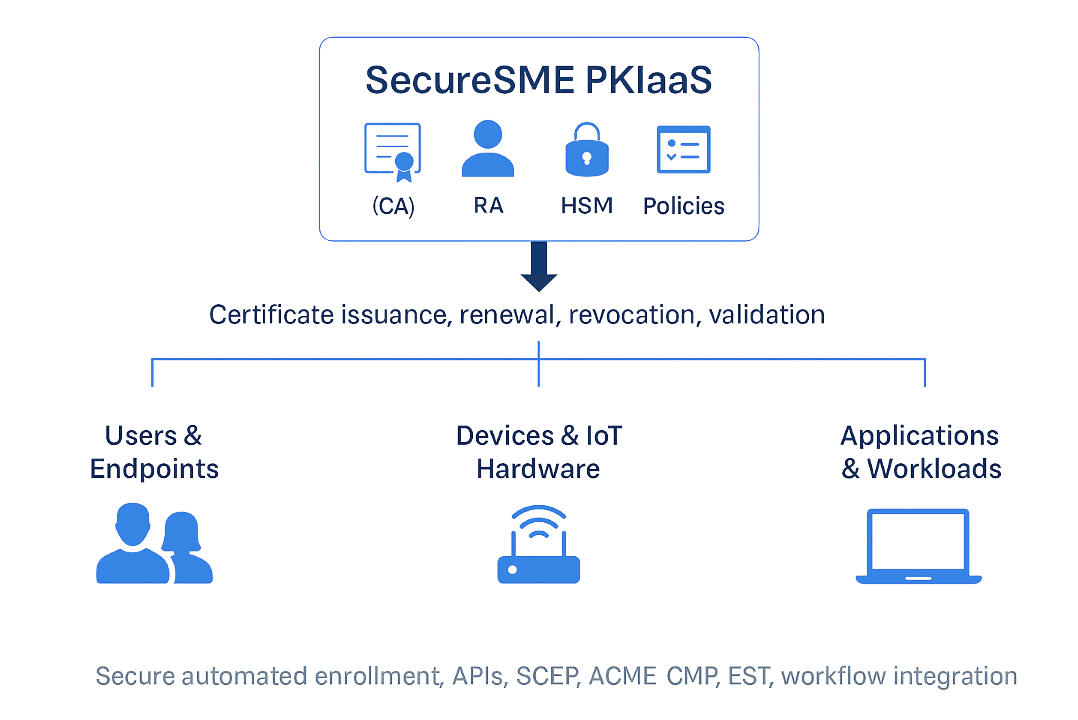
SecureSME provides all operational PKI components including Certificate Authorities, Registration Authorities, Hardware Security Modules, policy management, and end‑to‑end lifecycle automation. It also includes a full Certificate Lifecycle Management (CLM) capability.
Organisations interact with PKI services through modern, standards‑based protocols that simplify certificate lifecycle operations and reduce administrative overhead.
Key features of SecureSME PKIaaS
SecureSME PKIaaS provides a comprehensive suite of capabilities designed to deliver secure, automated, and scalable certificate management across the entire organisation. The service supports both modern and
legacy environments, enabling seamless integration regardless of platform maturity.

1. Full Certificate Lifecycle Automation
SecureSME eliminates manual effort at every lifecycle stage through:
- Automated issuance for users, devices, servers, workloads, and applications
- Automated renewals that prevent certificate-related outages
- Auto-replacement and rotation of keys and certificates
- Policy-guided lifecycle tasks to maintain cryptographic hygiene
- Integration with workflow engines and identity platforms
Supported automation standards include:
- ACME and ACME+ for modern cloud and DevOps platforms
- SCEP for devices, MDM, and network equipment
- CMP and EST for secure enrollment workflows
- Windows Auto Enrolment for AD-joined endpoints
- REST APIs for custom orchestration

2. Broad Integration Ecosystem
SecureSME integrates with:
- Microsoft AD, Entra ID, and ADCS
- Intune and other Mobile Device Management systems
- Load balancers, firewalls, web servers, and reverse proxies
- API gateways, Kubernetes clusters, service meshes, and microservices
- IoT provisioning frameworks and device identity platforms
- Network infrastructure such as VPN, Wi-Fi (802.1X), and NAC

3. Security, Compliance, and Governance
With SecureSME PKIaaS, organisations benefit from:
- FIPS 140-2 Level 2 and 3 HSMs protecting all CA private keys
- Separation of duties between administrators and operators
- Comprehensive audit logging for all PKI operations
- Enforced crypto standards (RSA/ECC/PQC readiness)
- Compliance with ISM, Essential Eight, ISO27001, and DISP requirements

4. High Availability and Resilience
SecureSME PKIaaS is hosted in accredited Australian data centres with:
- Redundant Certificate Authorities and Registration Authorities
- Multi-site HSM clusters with automated failover
- Geo-redundant service endpoints
- Continuous monitoring and performance optimisation
.svg)
5. Role-based Access Control
SecureSME provides granular control over PKI operations including:
- Administrator roles
- Approver roles
- Read-only roles
- Delegated authority models
Benefits of SecureSME PKIaaS for Enterprise Security
SecureSME PKIaaS provides a broad range of security, operational, and financial benefits. As organisations adopt hybrid architectures, cloud platforms, mobile workforces, and increasingly automated ecosystems, cryptographic identity becomes foundational for Zero Trust and secure digital transformation.
1. Reduced Risk of Outages
Expired certificates are a top cause of enterprise service failures. SecureSME eliminates this risk through:
- Automated renewals and enforcement of lifecycle policies
- Continuous certificate monitoring and proactive alerts
- System-wide visibility into all certificate dependencies
2. Enhanced Security and Zero Trust Readiness
Cryptographic identity is central to Zero Trust. SecureSME PKIaaS strengthens identity assurance for:
- Users and administrators
- Devices and endpoints
- Applications, services, and APIs
- Cloud workloads and containers
- Network controls (VPN, Wi-Fi/802.1X, NAC)
3. Improved Operational Efficiency
SecureSME reduces the internal burden of managing certificates by:
- Eliminating manual issuance, renewal, and revocation tasks
- Reducing audit preparation time with structured reporting
- Automating complex lifecycle operations
4. Cloud, DevOPS, and Microservices Enablement
Modern applications require automated, scalable certificate-based authentication. SecureSME supports:
- mTLS identity for microservices
- Automated workload identity management in Kubernetes
- Integration with CI/CD pipelines for fast deployment cycles
- Certificate automation for API security and cloud-native workloads
5. Lower Cost of Ownership
On-premises PKI requires:
- Hardware Security Modules
- Dedicated servers
- Specialist PKI engineers
- Ongoing maintenance and auditing
SecureSME PKIaaS replaces all of this with:
- Predictable subscription pricing
- No infrastructure cost
- No specialist staff required
- Built-in compliance and governance
6. Future-proof Cryptography
SecureSME prepares organisations for:
- Cryptographic agility
- Stronger algorithms and key lengths
- Post-quantum cryptography (PQC) readiness
On-Prem VS Cloud PKI Comparison
Organisations evaluating PKI strategy often compare traditional on-premises deployment with a modern managed service model. The differences are significant in cost, complexity, agility, and security. SecureSME PKIaaS provides a more resilient and cost‑effective option for most enterprises and government agencies.

On-Prem PKI Challenges:
- High upfront capital investment for HSMs, servers, and licensing
- Specialist PKI engineers required to maintain and operate the platform
- Manual certificate lifecycle processes prone to outage-causing errors
- Slow scaling and costly upgrades
- Shared responsibility between multiple internal teams
- Inconsistent compliance enforcement

SecureSME PKIaaS Advantages:
- Predictable subscription model with no hardware to purchase
- Fully managed PKI infrastructure operated by experts
- Automated certificate lifecycle prevents outages
- Built-in compliance and governance aligned with ISM, ISO27001, DISP
- Geo-redundant, high-availability infrastructure
- Fast onboarding with modern automation protocols
High-Level Comparison:

More Than Just a CLM:
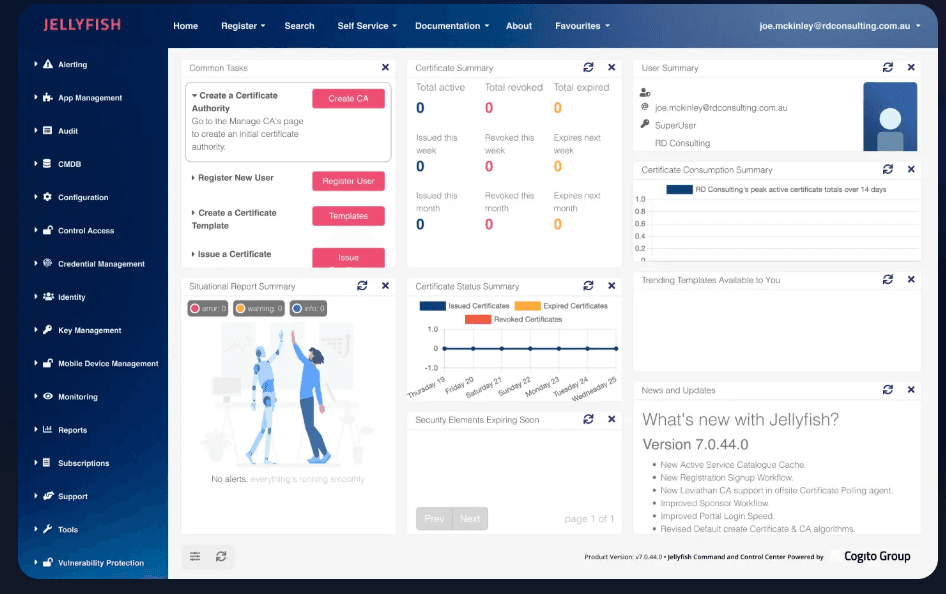
The Jellyfish PKI functions as a full key and credential management service, managing keys of all type and in all locations. Everything from keys stored in software, to smartcards, tokens and even Hardware Security Modules. The Jellyfish PKI also has a CLM, CA, RA, CMS, CMDB, IdAM and many other components embedded in the one platform.
FAQs


Experience secure PKI and Key Management as a Service
Demos available online